
01
Session 1 · 20 min
From light to pixels
What does a camera give the computer?
Understand it
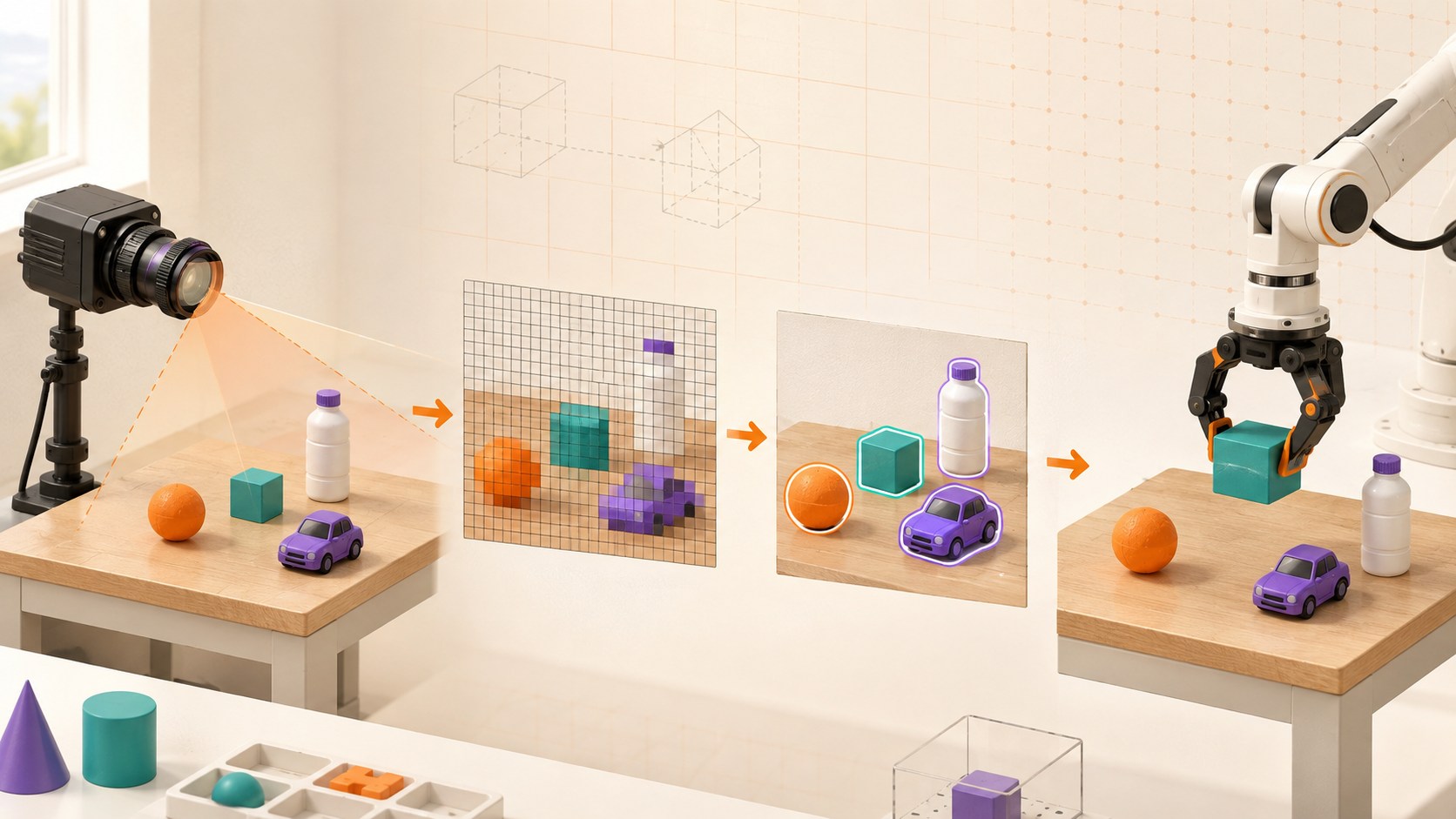
A lens focuses light onto a sensor. The sensor samples the scene into a grid of pixels. Each pixel stores intensity or colour-channel values. Resolution controls spatial detail, while exposure affects brightness and blur.
Choose a step to inspect it, or run the complete sequence.
Sequence progress 1 / 4
Picture it
A useful analogy
A mosaic represents a scene using many small coloured tiles; step back and the picture appears.
Apply it
Worked example
A 640 × 480 image contains 307,200 pixel positions, each with one or more channel values.
Try it
- Draw an 8 × 8 pixel icon on squared paper.
- Encode dark and light squares as 0 and 1.
- Explain what detail is lost at low resolution.
Quick checkDoes one pixel know which object it belongs to?
Answer: No. A pixel only stores measured values; algorithms infer structure from patterns across pixels.