
Intermediate · visual course

OpenCV

OpenCV provides tested building blocks for turning images and video into measurable computer-vision results.

OpenCVPythonC++ 4 guided sessions 8 skill tracks 3 example projects
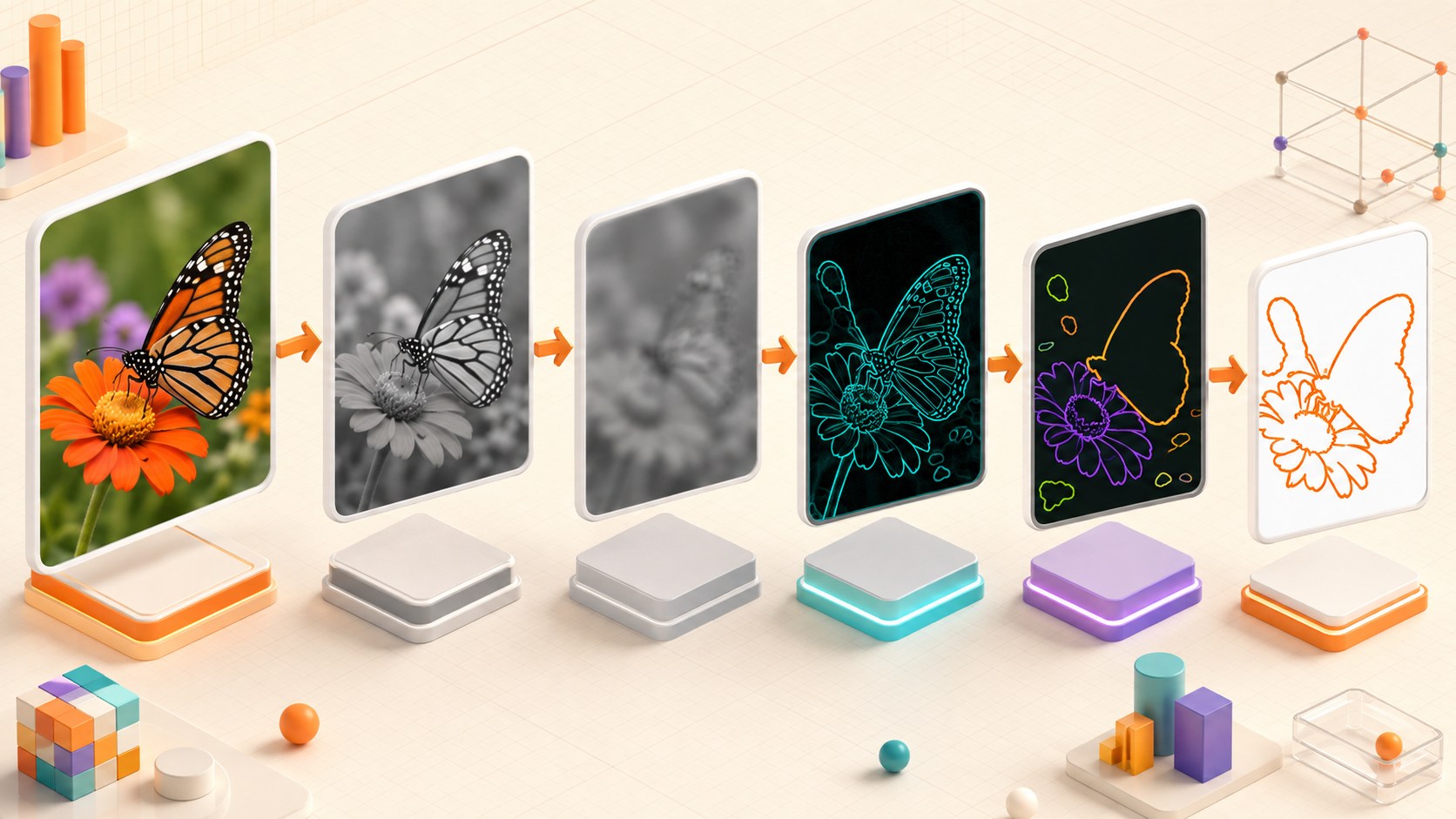
Three-dimensional sequence showing colour image, grayscale, blur, edges, contours and final outline
Concept overview · generated for this Academy4Tech lesson
Start here

See the system, then build it.

Display or save every intermediate image. A visible pipeline is much easier to debug than one final answer.

01Load, inspect and save image arrays
02Use colour conversion, blur, threshold and edges
03Measure contours and regions of interest
04Build a camera loop with checks and clear output
Your progress Keep your learning momentum going

0 of 4 sessions complete

Interactive 3D learning studio

OpenCV pipeline studio

Build an observable image-processing pipeline from capture through filtering to measurement.

Interactive system model · loads on request Poster mode
Explore the system in 3D Inspect the labelled subsystems and watch their modelled process. The lesson flow beside it is a separate conceptual sequence unless it explicitly names the same subsystem. The poster remains available if WebGL is unsupported.
Selected lesson · conceptual flow

Images are arrays

How does OpenCV represent a picture?

Step 1 of 4 · Image file

Step through this lesson’s conceptual sequence here. Inspect the separate 3D subsystem model below it to understand the system’s structure.

3D subsystem inspector · 4 model parts
Mini experiment

Change one variable. Predict first, then test.

Use an odd kernel from 3 to 7 pixels.

5 px
Live result Move the control to test your prediction

Use an odd kernel from 3 to 7 pixels.

Every highlighted 3D group corresponds to a labelled system part. A slider changes the model only when that relationship can be represented faithfully; otherwise the geometry stays still and the live calculation explains the effect. The model simplifies scale and geometry, so use the lesson’s safety notes, measurements and official documentation when building a real system.

01
Session 1 · 20 min

Images are arrays

How does OpenCV represent a picture?

Understand it

OpenCV loads an image into a matrix-like array. Rows come before columns, and a colour image usually has multiple channels. In common OpenCV Python workflows, colour order is BGR rather than RGB, so conversion matters when using other libraries.

Interactive concept flow

Step 1 of 4 Image file

Choose a step to inspect it, or run the complete sequence.

Sequence progress
1 / 4
Picture it

A useful analogy

A spreadsheet cell has a row, column and value; a colour pixel has a row, column and channel values.

Apply it

Worked example

Load an image, inspect shape and dtype, read one pixel, then save a grayscale copy.

Example codeRead each line, predict, then run
import cv2 as cv

image = cv.imread("object.jpg")
print(image.shape, image.dtype)
gray = cv.cvtColor(image, cv.COLOR_BGR2GRAY)
cv.imwrite("object-gray.png", gray)
Try it
  1. Create a tiny coloured grid on paper.
  2. Index three cells as row, column.
  3. Predict the array shape for height 100, width 200 and three channels.
Quick checkFor img[y, x], which coordinate comes first?

Answer: The row or y-coordinate comes first, followed by the column or x-coordinate.

02
Session 2 · 25 min

Build a processing pipeline

Why use several small image operations?

Understand it

Each operation solves one problem. Colour conversion simplifies channels, blur reduces small noise, thresholding creates a mask, and edge detection finds rapid change. The correct order depends on the scene and desired measurement.

Interactive concept flow

Step 1 of 4 Colour

Choose a step to inspect it, or run the complete sequence.

Sequence progress
1 / 4
Picture it

A useful analogy

Preparing a science sample may require filtering, staining and viewing—each step reveals something different.

Apply it

Worked example

Convert to grayscale, apply a small Gaussian blur, then use Canny edges to reveal a part boundary.

Example codeRead each line, predict, then run
gray = cv.cvtColor(image, cv.COLOR_BGR2GRAY)
blurred = cv.GaussianBlur(gray, (5, 5), 0)
edges = cv.Canny(blurred, 60, 140)
Try it
  1. Run or inspect the same image with two blur sizes.
  2. Record which edges disappear.
  3. Explain the trade-off between noise and detail.
Quick checkCan excessive blur remove useful information?

Answer: Yes. It reduces noise but can also erase small edges and features.

03
Session 3 · 25 min

Contours and measurements

How can a binary shape become useful numbers?

Understand it

Contours describe connected boundaries in a binary image. From a contour, software can calculate area, perimeter, centre and bounding rectangle. A region of interest limits work to the part of the image that matters.

Interactive concept flow

Step 1 of 4 Binary mask

Choose a step to inspect it, or run the complete sequence.

Sequence progress
1 / 4
Picture it

A useful analogy

Tracing the coast of an island lets you estimate its boundary and area without studying the whole ocean.

Apply it

Worked example

Find contours in a thresholded image, reject tiny areas as noise, then draw a box around the largest remaining object.

Try it
  1. Draw three blobs on grid paper.
  2. Estimate each area.
  3. Write a rule that rejects small specks but keeps the main object.
Quick checkWhy filter contours by area?

Answer: It can remove small noise and keep shapes large enough to be relevant.

04
Session 4 · 30 min

A dependable camera loop

What makes video processing more than a repeated image script?

Understand it

A video loop must confirm the camera opened, check every frame, process within the available time, show or record results and release resources. Use a measured frame rate and make failure visible rather than silently using stale data.

Interactive concept flow

Step 1 of 4 Capture

Choose a step to inspect it, or run the complete sequence.

Sequence progress
1 / 4
Picture it

A useful analogy

A live sports commentator must keep receiving current play, speak on time and report if the feed stops.

Apply it

Worked example

Capture a frame, detect an object, overlay the measured centre, exit on a key, and release the camera cleanly.

Try it
  1. Write pseudocode for a safe camera loop.
  2. Add a frame-failure branch.
  3. Choose one timing measurement to record.
Quick checkWhy check the frame-read result?

Answer: The camera may disconnect or fail; processing invalid data can produce crashes or misleading results.

Beyond the guided sessions

Explore the whole OpenCV field

The guided sessions teach the foundations. This map widens the view across 8 important tracks, with explanations, practice prompts, knowledge checks, and official sources for deeper study.

Implement measurable image and video pipelines with concrete OpenCV APIs, parameter experiments, diagnostics, and deployment checks, building on the Computer Vision topic’s theory.

Field map 0 of 8 tracks explored
Open a track to add it to your journey.
  1. Foundation OpenCV foundations
    Track overview

    This implementation-focused topic treats OpenCV images as numeric matrices, so version, loading, shape, channel order, data type, and API return checks come before every algorithm.

    Core concepts

    Four ideas to understand

    1. installation and version checks

      Install one compatible OpenCV package for the environment and print the runtime version and build information. Examples may differ across versions and optional modules, so record both code and environment.

    2. matrix image model

      In Python, an image is usually a NumPy array whose shape, dtype, and strides describe its pixels. Color images loaded by OpenCV normally use BGR channel order rather than RGB.

    3. image read and write

      On failure, Python cv2.imread normally returns None, while C++ imread returns an empty Mat; imwrite reports success separately. Check the language-specific result, preserve intentional bit depth, and remember that lossy formats alter pixels.

    4. pixel inspection

      Indexing exposes individual pixels or regions of interest, while array operations transform many values efficiently. Copy a region when it must be independent because a slice may share the original memory.

    Check your thinking What channel order does OpenCV normally use for a loaded three-channel color image?
    Answer

    OpenCV normally loads a three-channel color image in blue, green, red (BGR) channel order.

  2. Foundation Color and enhancement
    Track overview

    Color conversion and enhancement can expose useful structure, but parameters and numeric ranges must match the image and the intended measurement.

    Core concepts

    Four ideas to understand

    1. color conversion

      cvtColor converts between representations such as BGR, grayscale, HSV, and Lab using a specific conversion code. Choose the correct source order; displaying BGR as RGB swaps red and blue.

    2. histograms

      A histogram counts pixel values by bin and reveals distribution, clipping, or contrast. It discards spatial arrangement, so different images can have the same histogram.

    3. contrast adjustment

      Linear scaling changes gain and offset, histogram equalization redistributes intensity globally, and CLAHE operates on local tiles with clipping. Evaluate whether enhancement also amplifies noise or changes downstream measurements.

    4. denoising

      Gaussian, median, bilateral, and learned filters assume different noise and edge behavior. Select kernel size from the artifact scale and compare results against preserved details, not only visual smoothness.

    Check your thinking Why can two visually different images have the same intensity histogram?
    Answer

    A histogram counts values but does not record where those pixels occur.

  3. Applied Binary images and shapes
    Track overview

    Thresholds create foreground masks, morphology repairs scale-specific defects, and region tools turn masks into measurable objects.

    Core concepts

    Four ideas to understand

    1. adaptive thresholding

      threshold applies one boundary globally, while adaptiveThreshold calculates a local boundary from each neighborhood. Local methods help uneven illumination but window size and offset can create artifacts.

    2. morphology

      erode and dilate shrink or grow foreground according to a structuring element. morphologyEx combines them for opening, closing, gradients, and top-hat operations.

    3. contours

      findContours extracts ordered boundaries from a binary image, with retrieval mode controlling hierarchy and approximation mode controlling stored points. Measure a clean mask and retain coordinate offsets after cropping.

    4. connected components

      connectedComponentsWithStats assigns a label to each connected region and returns area and bounding data. Connectivity choice determines whether diagonal pixels belong together.

    Check your thinking Which OpenCV morphology usually removes small bright foreground specks?
    Answer

    Opening, which applies erosion followed by dilation.

  4. Applied Edges and geometry
    Track overview

    OpenCV combines gradient-based structure detection with geometric models that transform images or locate lines, circles, and planes.

    Core concepts

    Four ideas to understand

    1. Canny edges

      Canny smooths the image, finds gradients, thins responses, and tracks edges between two thresholds. Thresholds and blur should be selected from expected contrast and noise.

    2. Hough transforms

      Hough methods vote in parameter space for lines or circles supported by edge points. Resolution and vote thresholds trade missed shapes against duplicate or false detections.

    3. affine transforms

      warpAffine applies a 2 by 3 transformation for translation, rotation, scale, shear, or affine point mapping. Interpolation and border rules affect the resampled pixels.

    4. homographies

      findHomography estimates a projective mapping from point correspondences, often with RANSAC to reject outliers. warpPerspective can rectify a plane, but the model is not valid for arbitrary non-planar depth change.

    Check your thinking How many non-collinear point correspondences are minimally required to estimate a general homography?
    Answer

    At least four point correspondences in a non-degenerate configuration are required for a general homography.

  5. Applied Features and cameras
    Track overview

    Local features connect views, while calibration and pose routines turn those correspondences into camera and object geometry.

    Core concepts

    Four ideas to understand

    1. feature matching

      Detectors such as ORB or SIFT find keypoints and descriptors, while BFMatcher or FLANN proposes descriptor pairs. Apply descriptor-appropriate distance, ratio or cross checks, then verify geometry.

    2. camera calibration

      calibrateCamera estimates intrinsics and distortion from known 3D-to-2D pattern correspondences across varied views. Keep image size consistent and inspect per-view as well as overall reprojection error.

    3. distortion correction

      Lens distortion bends the ideal projection, especially toward image edges. undistort or precomputed remap tables correct it using calibration parameters, at the cost of cropping or undefined borders.

    4. pose estimation

      solvePnP estimates object-to-camera rotation and translation from known 3D points and their 2D image positions. Planar ambiguity, noisy points, wrong calibration, and coordinate conventions can produce a plausible but incorrect pose.

    Check your thinking What does reprojection error compare during camera calibration?
    Answer

    Observed image points with points projected by the estimated camera and distortion model.

  6. Advanced Detection and tracking
    Track overview

    OpenCV supports classical and neural detectors plus temporal trackers, but the application must manage preprocessing, confidence, identity, and recovery.

    Core concepts

    Four ideas to understand

    1. cascade classifiers

      CascadeClassifier applies a trained cascade over image scales for classical detection. It is lightweight but sensitive to pose and domain, and the XML model must match the intended object.

    2. DNN inference

      The dnn module loads supported trained networks and runs forward inference; it does not provide a full training framework. Inputs must match the model layout, size, channel order, scaling, and mean.

    3. object trackers

      A tracker updates a target region between detections using motion or appearance. Tracker availability can depend on the OpenCV build, and drift requires confidence checks and periodic re-detection.

    4. non-maximum suppression

      NMS keeps high-scoring boxes and removes strongly overlapping alternatives according to a threshold. It can mistakenly suppress nearby real objects, so test crowded scenes.

    Check your thinking Why must a DNN input use the same scaling and channel order as model training?
    Answer

    Changing preprocessing changes the numeric feature distribution the learned weights expect.

  7. Advanced Video pipelines
    Track overview

    A dependable OpenCV video pipeline validates capture and timing, bounds latency, models the background carefully, and records with known codec behavior.

    Core concepts

    Four ideas to understand

    1. video capture

      VideoCapture opens a camera, stream, or file and returns a success flag with each frame. Backend, device permissions, negotiated resolution, and disconnects must all be checked.

    2. frame timing

      File FPS metadata does not guarantee live-camera delivery time, so timestamp frames near capture with a monotonic clock. Bound queues or drop old frames when freshness matters more than completeness.

    3. background subtraction

      MOG2 and KNN background models identify changing foreground over time. Camera motion, shadows, lighting shifts, and learning rate can make the background model fail.

    4. codecs and output

      VideoWriter needs a filename, codec code, frame rate, size, and color expectation that agree. Codec availability varies by build and platform, so reopen and inspect a written test file.

    Check your thinking What should code test after each VideoCapture read?
    Answer

    The success flag and whether a valid frame was actually returned.

  8. Advanced Production OpenCV
    Track overview

    Production vision requires profiling the complete pipeline, validating optional acceleration, protecting image data, and defining safe behavior for stale or uncertain results.

    Core concepts

    Four ideas to understand

    1. vectorized operations

      OpenCV and NumPy operations process whole arrays in optimized native code and usually outperform Python pixel loops. Avoid unnecessary copies and conversions, but confirm that in-place edits do not corrupt shared data.

    2. profiling

      Measure capture, transfer, preprocessing, inference, postprocessing, and output separately with warm-up and representative inputs. Average time alone hides tail latency and dropped frames.

    3. hardware acceleration

      OpenCL, CUDA, CPU instruction sets, and DNN backends depend on how OpenCV was built and what each operation supports. Verify build information, numerical output, transfer overhead, temperature, and fallback behavior on the target.

    4. privacy-safe failure handling

      Minimize captured regions and retention, protect stored frames, and make recording visible and authorized. Reject stale or malformed frames, abstain on low confidence, and give safety-critical actions an independent fallback.

    Check your thinking Why should acceleration be measured end to end instead of timing only one kernel?
    Answer

    Data transfer, conversion, queues, and unsupported fallback operations can outweigh the faster kernel.

Verified next steps

Official references

Use these primary sources to extend the explanations and check current guidance.

  1. OpenCV OpenCV-Python Tutorials
  2. OpenCV Core Operations
  3. OpenCV Image Processing in OpenCV
  4. OpenCV Feature Detection and Description
  5. OpenCV Camera Calibration and 3D Reconstruction
  6. OpenCV Deep Neural Networks (dnn module)
  7. OpenCV Tracking API
  8. OpenCV OpenCV configuration options reference
  9. National Institute of Standards and Technology AI Risk Management Framework
Three-project build pathway

Learn OpenCV by making it work.

Start small, combine the ideas, then complete a measured challenge. Every project includes a material list, four build milestones, evidence to collect, and a safe next step.

  1. Starter · 60–90 minutes Visible Image-Pipeline Explorer Learn one dependable building block Build an OpenCV program that displays an image beside grayscale, blurred, thresholded, edge, and contour stages, with controls that help learners see exactly what each operation preserves or removes.
    What you will learn

    Learning goals

    • Read images safely and inspect shape, dimensions, channels, type, and value range.
    • Explain how blur, threshold, edges, and contours transform numeric arrays.
    • Use odd kernel sizes and validated control ranges to prevent confusing or invalid operations.
    Prepare

    Materials and tools

    • Python, OpenCV, and a local editor or notebook
    • Three supplied privacy-safe still images with different contrast and texture
    • Pipeline worksheet and parameter table
    • Window, notebook, or local web display for intermediate stages
    Build sequence

    Four milestones

    1. Load each image with an explicit missing-file check and report dimensions, channels, type, and intensity range.

    2. Implement named stages for grayscale, odd-kernel blur, threshold or edges, and contour overlay.

    3. Add bounded controls, captions, and a reset that make parameter changes and processing order visible.

    4. Record three parameter sets on three images and explain one benefit and one information loss at every stage.

    Prove it works

    Evidence to collect

    • All intermediate arrays appear with correct labels, compatible display ranges, and no crash on a missing image.
    • The learner can reproduce three saved parameter sets and connect each changed output to the intended operation.
    • The report identifies a failure where attractive output does not produce a correct measurement.
  2. Builder · 2–3 hours Calibrated Tabletop Measurement Board Connect multiple ideas into a working system Use a printed reference rectangle and OpenCV geometry to rectify perspective and measure paper objects, while reporting uncertainty and rejecting scenes outside the calibrated conditions.
    What you will learn

    Learning goals

    • Detect a reference, order corners, compute a perspective transform, and relate pixels to length.
    • Propagate calibration and repeatability limits into reported measurements.
    • Test viewpoint, lighting, edge quality, and occlusion systematically.
    Prepare

    Materials and tools

    • Python and OpenCV
    • Printed high-contrast reference rectangle with carefully verified dimensions
    • Flat paper shapes, ruler, plain surface, and fixed phone or webcam stand
    • Image set and repeatability table
    Build sequence

    Four milestones

    1. Define the measurement plane, supported size range, reference dimensions, camera setup, tolerance, and reject conditions.

    2. Detect and order reference corners, rectify the plane, segment objects, and overlay measured dimensions.

    3. Capture repeated images at planned positions and angles, compare results with ruler measurements, and calculate error.

    4. Add checks for missing reference, poor contour, occlusion, extreme perspective, and values outside the calibrated range.

    Prove it works

    Evidence to collect

    • A repeated-test table reports reference truth, estimate, absolute error, and conditions for at least 15 measurements.
    • Unsupported scenes return an explanatory invalid result rather than a plausible-looking number.
    • The demonstration shows original, detected reference, rectified plane, object contour, scale, and final measurement.
  3. Challenge · 4–6 hours Robust Tabletop Object Tracker Test, measure, and improve a complete solution Create a privacy-safe tracker for one brightly marked tabletop object in prerecorded or live video. Combine detection, temporal tracking, confidence, re-detection, performance measurement, and visible failure states.
    What you will learn

    Learning goals

    • Separate object detection, association, state estimation, tracking, and re-detection.
    • Measure localization quality, lost-track behavior, latency, and throughput on held-out sequences.
    • Design explicit recovery for occlusion, appearance change, fast motion, and out-of-frame events.
    Prepare

    Materials and tools

    • Python, OpenCV, and a local computer
    • Learner-owned brightly marked soft object and plain tabletop scene
    • Fixed webcam or prerecorded privacy-safe clips
    • Annotation, timing, test-sequence, and failure-log templates
    Build sequence

    Four milestones

    1. Define the target, capture boundary, held-out sequences, annotation method, confidence rule, lost state, and performance budget.

    2. Implement a visible detector and tracker with timestamped frames, bounded search, confidence, and re-detection logic.

    3. Create separate normal, occluded, fast, dim, distractor, and out-of-frame clips and label enough frames for evaluation.

    4. Measure overlap or centre error, lost and recovery time, false reacquisition, latency, and throughput; then document limits.

    Prove it works

    Evidence to collect

    • Evaluation uses held-out sequences and reports localization, loss, recovery, false reacquisition, and speed—not only a demo video.
    • The overlay distinguishes detected, tracked, uncertain, and lost states and never draws an assured box when evidence is absent.
    • The code releases cameras and windows on normal exit and failure, handles a missing or ended stream, and preserves a concise diagnostic log.
Words to know

Build your vocabulary.

Array
An indexed grid of values used to store an image.
BGR
Blue, green, red channel order commonly used by OpenCV.
Kernel
A small neighbourhood used by a filter.
Mask
An image that selects relevant pixels.
Contour
A connected boundary around a shape.
ROI
Region of interest: a selected part of an image.
Keep studying

Official documentation.

These lessons simplify the first ideas. Use the original documentation when building, checking details or moving to the next level.

Continue learning

Related Academy4Tech content.

Learn by building.

Choose a real project, identify the smallest subsystem you can test, and document what the measurement tells you.