
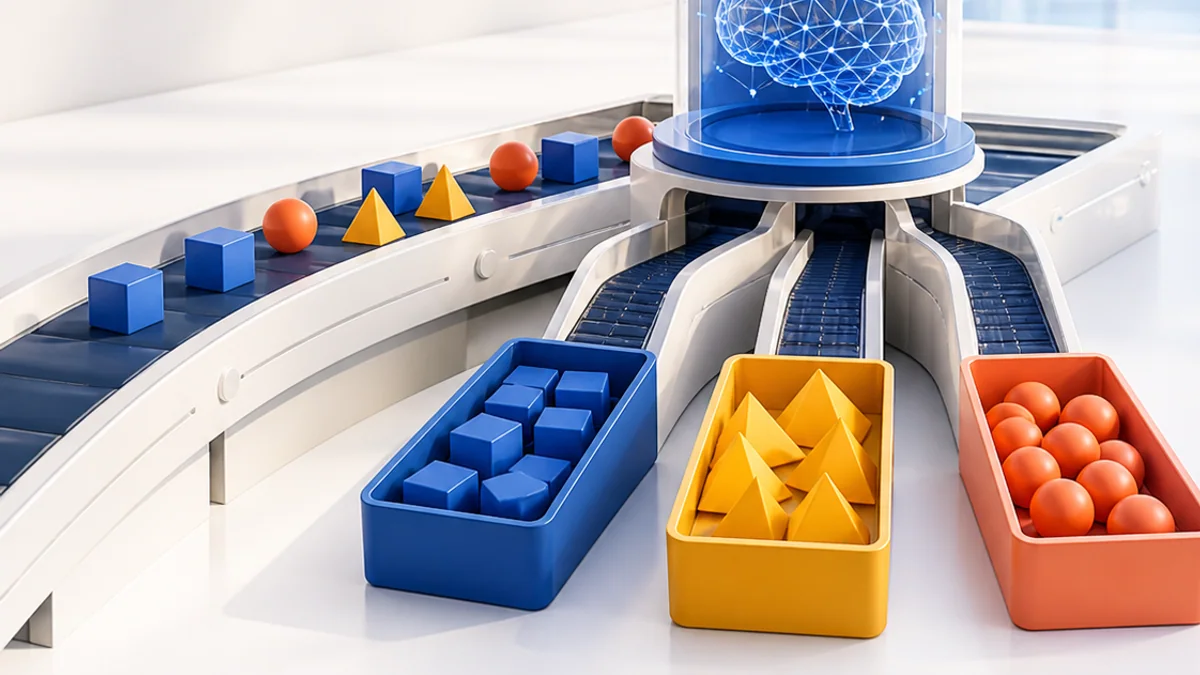
You can understand AI & Machine Learning without treating it as magic or memorizing a long list of terms. Start with one simple mental model, connect each part to an everyday example, and then add the technical details that make the system dependable.
The big idea: Machine learning finds useful patterns in examples; it does not understand a problem in the same way a person does.
A model can be mathematically accurate on its training data and still fail in the real world. Test the whole system.
Why this matters
AI is not magic and it is not automatically correct. It is a system for finding patterns in examples, producing a prediction and then measuring whether that prediction is useful enough for a particular decision.
By the end of this guide, you will be able to:
- Identify examples, features and labels
- Separate training, validation and test data
- Explain classification and regression
- Evaluate errors, bias and safe human oversight
The goal is not only to recognize the words. It is to explain the system, predict what it will do, and design a small test that produces evidence.
1. Learn from examples
The question: What does a machine-learning model actually learn?
A dataset contains examples. Features describe each example, and a label is the answer for supervised learning. Training adjusts model parameters so inputs map to useful outputs. The model learns statistical patterns, including unwanted patterns in poor data.
Think of it like this: Sorting many objects by examples can reveal a rule, but a misleading set of examples teaches the wrong rule.
A concrete example
Use colour and weight as features to classify recyclable objects, while checking that the background does not accidentally reveal the label.
The flow: Examples → Features and labels → Training → Model
Try it yourself
- Choose a simple classification task.
- Write two useful features and one misleading feature.
- Explain how you would label ten examples.
Quick check — What is a label?
It is the target answer associated with a training example in supervised learning.
2. Train, validate and test
The question: How do we know a model learned a pattern instead of memorising?
Training data adjusts the model. Validation data helps choose settings. Test data estimates performance on unseen examples and must not guide training. Overfitting happens when a model matches training details but performs poorly on new data.
Think of it like this: Practise questions teach you, a mock exam guides revision, and a sealed final exam measures what transfers.
A concrete example
Split plant images by individual plant, not random near-identical frames, so the test set is genuinely new.
The flow: Training set → Validation set → Locked test set → Real-world check
Try it yourself
- Divide 20 paper examples into three sets.
- Keep the test labels hidden while making a rule.
- Measure the final unseen result once.
Quick check — Why keep test data separate?
Using it to tune the model would make the final score overly optimistic.
3. Predictions and metrics
The question: Which score tells us whether a model is useful?
Regression predicts a number; classification predicts a category or probability. Accuracy alone can mislead when one class is rare. A confusion matrix separates true positives, false positives, true negatives and false negatives so the cost of each error is visible.
Think of it like this: A fire alarm that never rings is correct most of the time but useless when fire is rare.
A concrete example
For a safety detector, missing a hazard may cost more than a false alarm, so recall may matter more than overall accuracy.
The flow: Prediction → Compare truth → Count error types → Choose metric
Try it yourself
- Create a 2×2 confusion matrix for ten predictions.
- Count false alarms and missed cases.
- Decide which error matters most for your task.
Quick check — When can high accuracy be misleading?
When one class is much more common, a model can ignore the rare class and still appear accurate.

4. Responsible deployment
The question: What should happen before people depend on a model?
Test data quality, different user groups, unusual conditions and changes over time. Explain the model’s limits, monitor failures and provide human review for meaningful decisions. Protect private data and make it possible to stop or replace the model.
Think of it like this: A new team member needs a clear job, supervision, feedback and limits—not blind trust.
A concrete example
A school recycling assistant suggests a bin but lets the student correct it; corrections are reviewed before any retraining.
The flow: Test broadly → Explain limits → Human oversight → Monitor and improve
Try it yourself
- Write a model card for your classifier.
- List intended use, two limits and one group it may underserve.
- Add a human override and monitoring signal.
Quick check — Why monitor a deployed model?
Real-world data and conditions change, so performance can decline or new harms can appear.
Put the ideas together: Design a fair recycling classifier
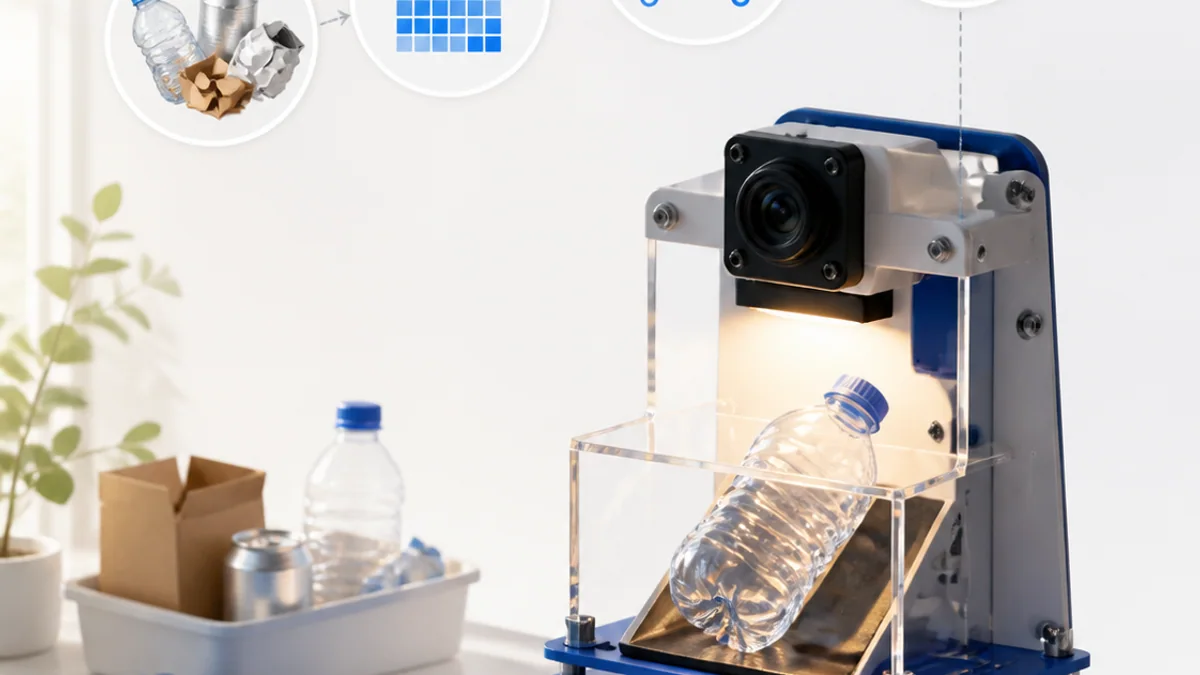
Plan a small image or feature-based model that suggests a recycling category and clearly communicates uncertainty.
Your build plan
- Define classes and collect balanced example types.
- Choose a train, validation and test split.
- Select metrics based on error cost.
- Write limits, privacy choices and human-override behaviour.
Evidence to keep
- Dataset plan
- Feature and label table
- Confusion matrix
- Short model card
An engineer does not stop at “it worked once.” Keep the diagram, record the conditions, repeat the test, and note what changed between attempts.
Important safety and quality notes
- Use non-sensitive example data while learning and testing.
- Check outputs instead of assuming software or a model is correct.
- Add human review whenever a mistake could affect a person or physical equipment.
The examples in this article are educational models. Check component ratings, manufacturer instructions, local rules and appropriate supervision before using real hardware.
Vocabulary without the jargon wall
| Term | Plain-language meaning |
|---|---|
| Feature | An input measurement used by a model. |
| Label | The target answer for a supervised example. |
| Training | Adjusting model parameters using examples. |
| Overfitting | Learning training details that do not generalise. |
| Classification | Predicting a category or class probability. |
| Regression | Predicting a numeric value. |
What to remember
Machine learning finds useful patterns in examples; it does not understand a problem in the same way a person does. The professional habit behind the technology is equally important: define the result, observe the system, measure what happened, and improve one thing at a time.
Continue with the full AI & Machine Learning learning path for the structured sessions, or explore the sources below when you are ready for deeper technical detail.
Sources and further learning
- Machine Learning Crash Course — Google for Developers
- Machine-learning exercises — Google for Developers
- TensorFlow tutorials — TensorFlow
Move a prediction threshold
The model confidence stays at 72%. Change the acceptance threshold to see how a product decision can change.
Move a slider to explore the model.
Remember: this is a simplified learning model, not a hardware design or safety calculator. Real systems also include limits, noise, timing and failure handling.