You can understand Embedded Systems without treating it as magic or memorizing a long list of terms. Start with one simple mental model, connect each part to an everyday example, and then add the technical details that make the system dependable.
The big idea: An embedded system combines dedicated software and hardware under real limits for time, memory, energy and safety.
Reliable embedded code responds to events, protects shared data and always has a defined safe state.
Why this matters
Embedded systems quietly control everyday products. They often have limited memory and strict timing needs, so clear states, predictable communication and safe recovery matter as much as the main feature.
By the end of this guide, you will be able to:
- Describe microcontroller memory, peripherals and firmware
- Choose GPIO, ADC, UART, I2C or SPI for a connection
- Explain polling, interrupts and timers
- Design a state machine with timeout and fault recovery
The goal is not only to recognize the words. It is to explain the system, predict what it will do, and design a small test that produces evidence.
1. Hardware meets firmware
The question: What makes a system embedded?
An embedded system is built into a product to perform focused functions. A microcontroller combines processor, memory and peripherals. Firmware starts at reset, initializes hardware and then handles events or repeats a control loop within limited resources.
Think of it like this: A washing-machine controller has one dedicated workplace, unlike a laptop that runs many unrelated applications.
A concrete example
A thermostat reads temperature, applies a control rule, drives a relay safely and updates a small display.
The flow: Reset → Initialize hardware → Read and decide → Control product
Try it yourself
- Choose one appliance.
- List its inputs, outputs and timing needs.
- Identify its safe state after a fault.
Quick check — What is firmware?
Software stored for and closely controlling an embedded device.
2. Pins and communication buses
The question: How do components exchange data?
GPIO handles simple digital states; ADC measures analog voltage. UART is an asynchronous serial link, I2C connects addressed devices on shared data and clock lines, and SPI uses separate clock and data paths for fast controller-peripheral exchange.
Think of it like this: Different roads suit a single driveway, a shared bus route or a fast dedicated delivery lane.
A concrete example
Use I2C for several low-speed addressed sensors and SPI for a display that needs faster transfers.
The flow: Peripheral need → Choose interface → Wire and configure → Validate data
Try it yourself
- Match four peripherals to interfaces.
- Count required signal wires.
- Check voltage compatibility and shared ground.
Quick check — What allows several I2C devices to share a bus?
Each compatible device uses an address on the shared clock and data lines.
3. Time, polling and interrupts
The question: How can a controller respond at the right moment?
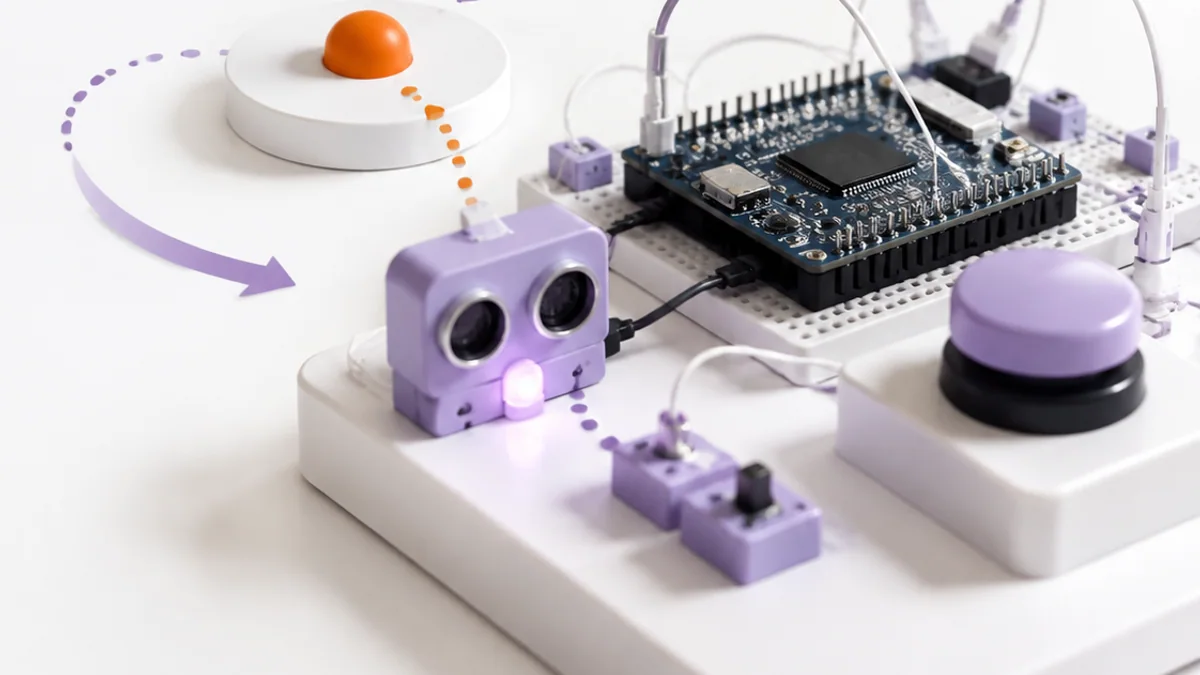
Polling repeatedly checks for change. An interrupt pauses normal flow to handle an event quickly, then returns. Hardware timers schedule precise events. Interrupt handlers should be short; lengthy work can be signalled for the main loop.
Think of it like this: Polling is repeatedly checking the door; an interrupt is a doorbell; a timer is an alarm clock.
A concrete example
A timer triggers sensor sampling every 10 ms while a button interrupt records an emergency request for the main loop.
The flow: Normal task → Event arrives → Short handler → Resume safely
Try it yourself
- Classify three events as polling, interrupt or timer.
- Draw a timing line.
- Mark work that should stay outside an interrupt handler.
Quick check — Why keep an interrupt handler short?
Long handlers delay other time-critical work and can make system timing unpredictable.
4. State machines and fault recovery
The question: How can behaviour stay clear as a product grows?
A finite-state machine lists valid states, events and transitions. Outputs depend on the current state. Timeouts prevent indefinite waiting, a watchdog can reset stalled software, and fault states put hardware into a safe condition while preserving useful diagnostic information.
Think of it like this: A lift has states such as doors open, doors closing and moving; only certain transitions are safe.
A concrete example
A motor controller moves from IDLE to RUN only after a start event, enters FAULT on overcurrent, and returns only after power is safe and a reset is requested.
The flow: State → Event or timeout → Guard condition → Next or fault state
Try it yourself
- Draw states for an automatic fan.
- Add sensor failure and over-temperature events.
- Define the output in every state.
Quick check — What is a safe state?
A defined condition that reduces risk when the system cannot continue normal operation.
Put the ideas together: Design a reliable mini incubator controller
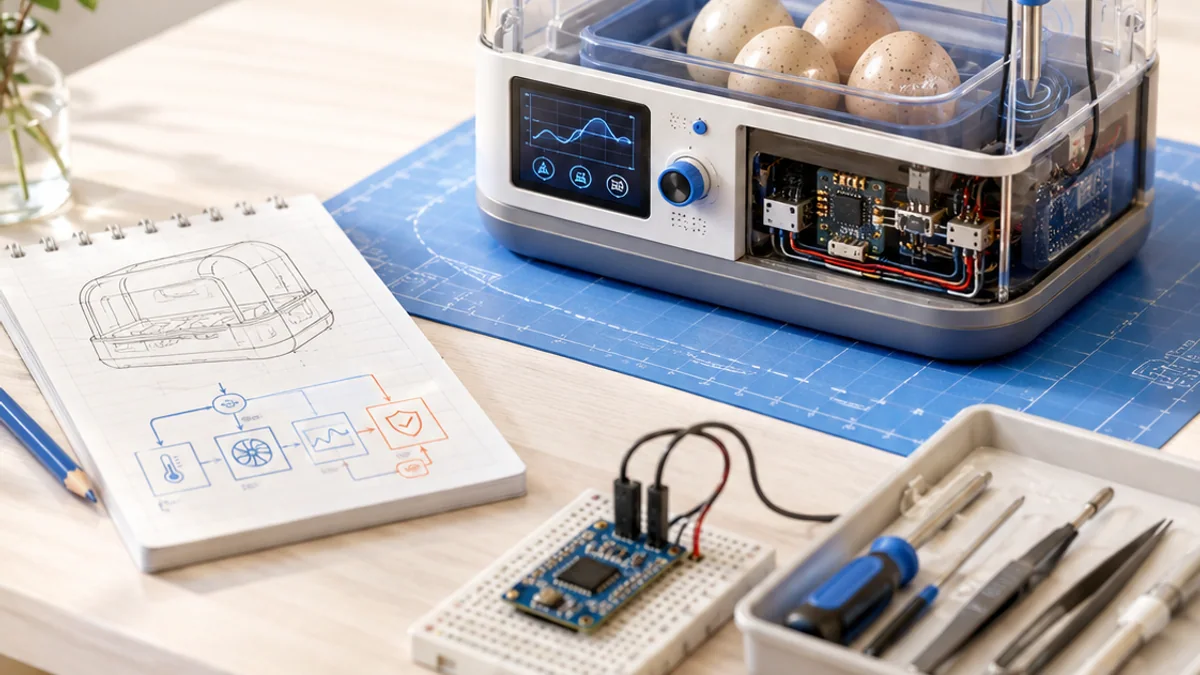
Plan firmware that reads temperature, controls a fan, updates a display and enters a safe state if sensing fails.
Your build plan
- Choose peripherals and interfaces.
- Define timing for sensing and display.
- Draw states, transitions and outputs.
- Add range checks, timeout and watchdog behaviour.
Evidence to keep
- Hardware block diagram
- Timing diagram
- State machine
- Fault-injection test plan
An engineer does not stop at “it worked once.” Keep the diagram, record the conditions, repeat the test, and note what changed between attempts.
Important safety and quality notes
- Use low-voltage loads or simulated outputs while learning.
- Separate motor power through a suitable driver.
- Choose a safe output state before enabling hardware.
- Treat watchdog reset as recovery, not a substitute for fixing faults.
The examples in this article are educational models. Check component ratings, manufacturer instructions, local rules and appropriate supervision before using real hardware.
Vocabulary without the jargon wall
| Term | Plain-language meaning |
|---|---|
| Firmware | Software closely tied to an embedded device. |
| Peripheral | Hardware controlled by or connected to the processor. |
| Interrupt | An event that temporarily redirects processor execution. |
| Timer | Hardware that measures or schedules time intervals. |
| State machine | Behaviour model built from states and allowed transitions. |
| Watchdog | A mechanism that detects stalled software and initiates recovery. |
What to remember
An embedded system combines dedicated software and hardware under real limits for time, memory, energy and safety. The professional habit behind the technology is equally important: define the result, observe the system, measure what happened, and improve one thing at a time.
Continue with the full Embedded Systems learning path for the structured sessions, or explore the sources below when you are ready for deeper technical detail.
Sources and further learning
- CMSIS introduction — Arm
- CMSIS-Core overview — Arm
- Arduino microcontroller learning resources — Arduino